


fabricant professionnel, depuis 2009.
répandre le parfum de l'amour partout dans le monde


français
Catégories
Nouveau blog
Scent Diffuser Noise: Pumps, Vibration and Resonance November 06 , 2026
 Scent diffuser noise can come from the pump's moving parts, airflow, vibration transferred into surrounding structures, and parts responding strongly at particular frequencies. What people hear depends on the sound source, its transmission path and the listening position. A useful check considers all three before blaming the pump or replacing the equipment.
A diffuser may seem unobtrusive during a busy store opening, then become noticeable when the room empties. A gentle hum may also sound different after a furniture change or relocation. These observations are useful, but they do not identify a fault by themselves.
For retailers, interior designers and fragrance equipment buyers, understanding the mechanisms makes sample reviews more productive. This guide explains air-pump sound, vibration and structural resonance, using DANQ A800L as the product example for documented specifications and floor placement.
An audible problem can involve several connected stages. First, something generates motion or pressure fluctuations. That energy then travels through air, through physical connections, or through both. Finally, a person hears the combined result at a particular location.
| Part of the problem | What it means | Useful first observation |
|---|---|---|
| Mechanical source | Moving components generate forces and sound | When does the sound begin within an operating cycle? |
| Airflow source | Moving air can create audible flow noise | Is a hiss associated with fragrance delivery? |
| Structural transmission | Vibration travels through connected solid parts | Is the base fully supported, with the body clear of furniture? |
| Resonant response | A structure responds strongly to excitation near a natural frequency | Does a particular tone change with installation conditions? |
These observations help describe the issue; they are not component diagnoses. A buzz does not automatically identify the motor, and a vibration does not automatically prove resonance.
In a pump-driven scenting system, the pump supplies moving air for the atomization process. Its drive and pumping action create mechanical activity alongside the airflow. The resulting sound can change with the pump design, its operating condition and the surrounding assembly.
Diaphragm pumps illustrate one possible mechanism. Pump manufacturer KNF explains that these positive-displacement pumps produce pulsation, which can contribute to vibration and noise. This is a general pump principle; the supplied A800L specification does not identify its pump type or internal mounting design.
Airflow adds another possible contribution. NIOSH's engineering-control guidance describes how turbulence and abrupt flow restrictions can increase noise. Applying this principle to scent equipment means considering the complete air path, rather than assuming every audible sound comes from the motor.
For an owner, the useful step is to describe when the sound appears: during delivery, at a transition, or throughout operation. Changes to internal tubing, valves or the atomizer belong with the manufacturer or authorized service team.
Sound can reach the listener through more than the direct air path. The OSHA Technical Manual explains that mechanical vibration can travel through solid connections to surfaces that radiate airborne sound. A structure elsewhere in an assembly can therefore contribute to what is heard.
In a diffuser installation, the practical questions include the support under the base and any contact between the housing and nearby objects. A unit touching a display cabinet creates a different physical connection from one standing clear of it. That connection should be recorded during an assessment.
Inside pump-based equipment, mounting and routing also matter. KNF's system-design guidance notes that vibrating tubing can create additional noise when it contacts other components or the casing.
These are reasons to assess the assembly and installation together. They do not establish that a particular A800L has an internal contact problem.
A structure has natural vibration characteristics. When a repeating force excites it at or near one of its natural frequencies, its response can become much larger. NI's vibration-measurement explanation describes this buildup of response as a feature of resonance.
Think of a swing receiving repeated pushes at a suitable rhythm: the motion can build even when each push is small. In equipment, the response depends on the structure and its damping. The analogy explains the mechanism; it does not assign a resonant frequency to a diffuser.
A housing panel, support or connected object may respond differently after its contact or restraint changes. That helps explain why installation can affect a particular tone without proving that the pump itself has become more powerful or defective.
Listening alone cannot confirm structural resonance. Identifying the mechanism may require controlled measurements of vibration, sound and operating conditions. A louder buzz is an observation to investigate, rather than sufficient evidence for that diagnosis.
DANQ's A800L Bluetooth-version specification, dated August 28, 2026, lists a noise figure of ≤38dB and describes a sealed chamber. It also identifies floor placement, dimensions of diameter 189mm × height 1,031mm, and an approximate machine weight of 2.6kg.
The sealed-chamber description is relevant to enclosure design. It does not quantify how much sound each component contributes or demonstrate a particular reduction in decibels. The supplied document also does not state the noise-test distance, frequency weighting or background conditions.
For a project, pair the listed figure with a demonstration of the supplied configuration. Keep the original dB unit and request the measurement conditions when comparing products. A figure measured under one setup cannot establish an identical result at every seat in a furnished room.
A800L's Bluetooth app and touch controls provide documented ways to select operation. Use the supplied instructions to keep the operating selection consistent during a listening review, while assessing its silver floor-standing form and ambient lighting separately from the sound.
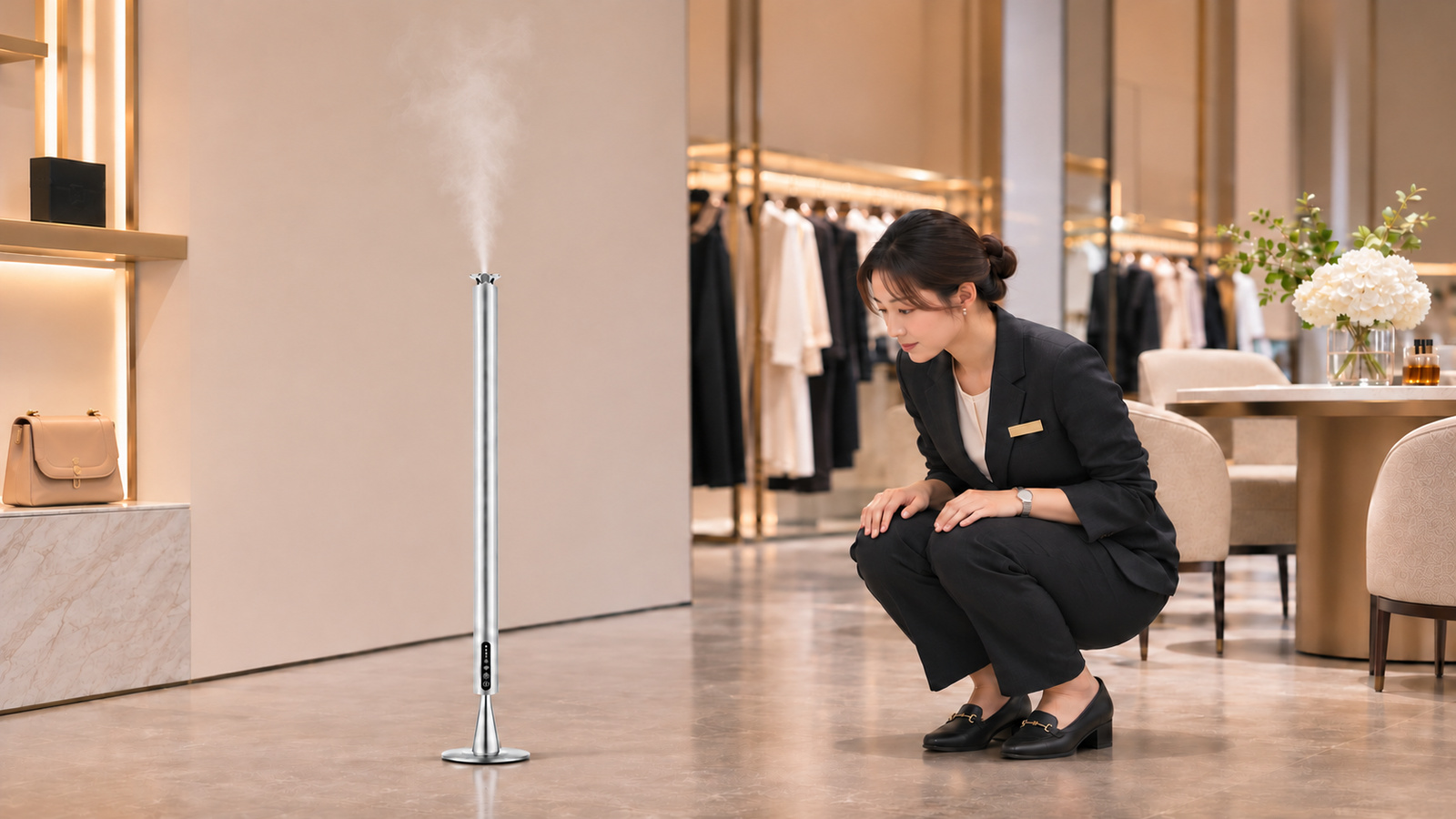 Begin with observations that do not require opening the diffuser:
Check full base support. Place A800L upright on a firm, level surface suitable for the approved floor installation. Look for rocking or a base crossing a floor-height change.
Check external contact. Leave the housing clear of cabinets, wall panels and loose display objects. Note any cable contact or tension that may affect the installation.
Check the operating state. Record the selected mode and whether the sound occurs during fragrance delivery or another part of the cycle. Compare equivalent states.
Check the room background. Note nearby ventilation, music, footsteps and other equipment. A change in background sound can change how noticeable the diffuser seems.
Record one change at a time. If relocation is appropriate, follow the supplied handling instructions, then repeat the observation with the same operating selection and listening position relative to the unit.
Vibration isolation, panel damping and acoustic enclosures serve different purposes. HSE's engineering guidance distinguishes these approaches. Choosing an accessory requires attention to the actual transmission path and the equipment's installation requirements.
Ask DANQ before adding an isolation accessory beneath a tall floor unit. NIOSH notes that incorrectly selected mounts can increase vibration. Maintain stable support and clear openings throughout any approved arrangement.
Send DANQ a photo or short recording of your A800L installation, together with the operating selection, floor surface and timing of the sound. This provides more useful context than the description “too noisy” alone.

A customer seated in a consultation lounge experiences the equipment differently from an installer leaning toward the outlet. Review the location where people normally read, browse or speak with staff, and include the quietest representative period of use.
First listen with the diffuser stopped, then observe normal operation under otherwise comparable conditions. Keep the room arrangement and listening position consistent. Record whether the concern is a steady tone, a hiss, intermittent contact noise or a change during a cycle.
Sound character matters alongside overall level. Two installations can attract different comments because one contains a noticeable tone or an intermittent rattle. Those descriptions give the supplier a starting point for investigation.
Recordings can document timing and sound character, but phone microphones and recording processing vary. Formal numerical comparisons require a suitable measurement method. A furnished-room listening review and a supplier's declared noise figure answer related but different questions.
For an OEM/ODM sample review, agree on the operating state, support arrangement, measurement method and acceptance criteria before comparing units. Consistent conditions make the result easier to interpret and repeat.
A new rattle, scraping sound or sudden increase deserves attention, especially if it arrives with changed fragrance output, visible leakage or unstable operation. Stop using the equipment and follow the supplied support procedure when an abnormal condition is suspected.
Provide the model, operating selection, a description of the change and any recent cleaning or relocation history. Keep inspection within the permitted user-maintenance instructions. Identifying an internal source is a service task, not a reason to modify the sealed chamber or pump assembly.
The support surface, nearby contact, room reflections and listening position may have changed. Compare the installation and operating conditions before concluding that the device has developed a fault.
No. Resonance is a particular response to excitation near a natural frequency. Vibration can occur without that condition, and listening alone does not confirm it.
No. A hum can involve normal mechanical activity or the surrounding assembly. Describe its timing and any change from previous operation, then seek advice if the behavior is abnormal.
Use only an arrangement approved for the product and location. A soft support can affect stability, and unsuitable isolation can increase vibration. Ask DANQ to review the proposed accessory.
No. The specification lists a noise figure, not inaudibility in every room. Request the test conditions and review a sample under representative use.
No. An enclosure is one design element. Mechanical excitation, airflow, transmission paths and the room still need to be considered together.
Understanding scent diffuser noise starts with the source, the path and the listening position. Check the pump-related activity, physical connections and structural response as separate possibilities, then use observations and measurements suited to the question.
DANQ has developed and manufactured scent equipment since 2011 and supports OEM/ODM projects. For an A800L installation, share the venue layout, intended operating selection and acoustic expectations alongside the fragrance requirements.

fabricant professionnel, depuis 2009.
répandre le parfum de l'amour partout dans le monde


Guangzhou DANQ Environmental Technology Co.,LTD
